Bowl Bound: Celebrating The Present ... Building For The Future
Matt Gilpin, Maryland Athletics Staff Writer
12/3/2021
As time ticked down in Maryland football’s regular season finale against the Rutgers Scarlet Knights on Nov. 27, Tarheeb Still, Ami Finau and Anthony Booker Jr. doused head coach Michael Locksley with the ceremonial water cooler bath, celebrating the culmination of a three year process to become bowl eligible.
Doing it for his hometown school.
— Maryland Football (@TerpsFootball) November 27, 2021
The best is ahead. pic.twitter.com/UPI1nhelab
The Terps spent the 2021 season looking to take that next step as a program, and a win against Rutgers represented just that as Maryland became bowl eligible for the first time in five years and the first time under Locksley.
Despite the Terps’ adversity, from injuries to heartbreaking losses, the team never wavered in its resolve. Maryland went into New Jersey and railroaded the Scarlet Knights to the tune of a 40-16 win.
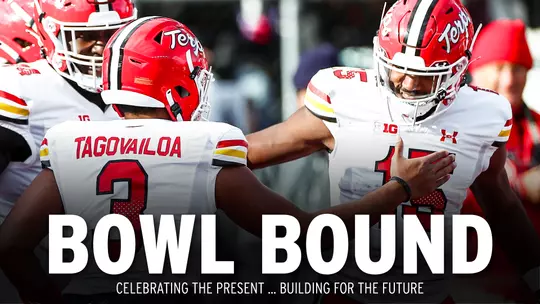
The team proceeded to empty the sideline and begin celebrating with each other on the field. Locksley and his crew punctuated the win with a group photo on the field
“I’m very proud of our team,” Locksley said. “It’s been a long season for us, and we very rarely talk about injuries, and we don’t make excuses. I think all three phases contributed in some form or fashion. It wasn’t pretty, but it was enough. I’m really proud of the 25 seniors because I understand what they’ve endured. They’ve done a great job as far as leadership and continued to practice to the standard that we set. I’m really happy for those guys. I’m looking forward to developing our team with this bowl opportunity.”
"When we faced adversity, we kept fighting. That's what Terps do!"@CoachLocks #TBIA pic.twitter.com/6aQlP1Awlc
— Maryland Football (@TerpsFootball) November 27, 2021
When Maryland football defeated the West Virginia Mountaineers 30-24 on Sept. 4, buoyed by a four-headed offensive attack of Taulia Tagovailoa, Tayon Fleet-Davis, Rakim Jarrett, and Dontay Demus Jr., hopes remained incredibly high. The following three weeks saw the team defeat Howard, Illinois, and Kent State to start 4-0, and reaching a bowl game seemed inevitable.
However, injuries began to pile up, with wideouts Demus Jr. and Jeshaun Jones, starting defensive back Deonte Banks and starting linebacker Fa’Najae Gotay, all suffering season-ending injuries. Not only did that take a toll on the team’s depth, but also began to wear on the team physically and mentally.
The win against Indiana on Oct. 30 saw wide receiver Carlos Carriere, one of the players who stepped up to replace Demus Jr.’s production, break out with eight catches for 134 yards and two touchdowns, including a crucial 45-yard catch and run in the fourth quarter.
Carriere wasn’t the only unheralded player to become a key contributor as the offense, defense, and special teams were each littered with players who ended up becoming difference makers.
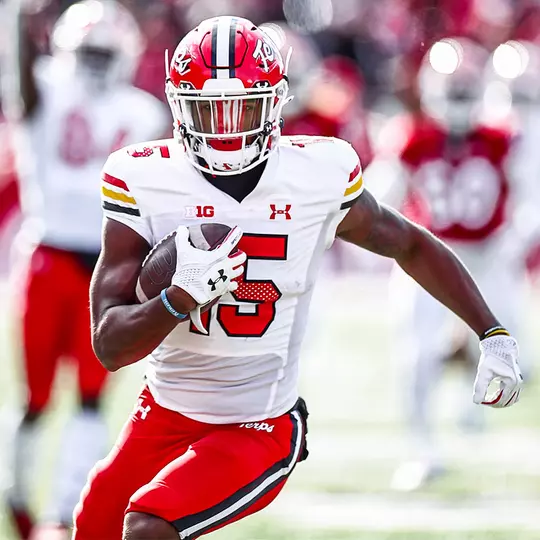
The Rutgers game showcased Maryland’s depth. Corey Dyches and Brian Cobbs, two players who also entered the season listed second at their respective positions on the depth chart, scored the game’s first two touchdowns.
Cobbs is a player that Locksley reveres as both an athlete and leader, and him scoring a key touchdown to boost and extend the team’s season was poetic for the Terps head coach.
“I was happy for Brian Cobbs,” Locksley said. “He’s one of the 25 seniors that I keep applauding that has brought a culture that we’re trying to establish. He’s played an integral role from a leadership standpoint and embodies the unselfishness that’s necessary for any type of program when you’re building it. To come in and have players like him and (Lawtez) Rogers, you know some of the veteran seniors that have been through an awful lot, you can’t begin to measure the amount of what he brings to the table.”
The defense also saw a lot of turnover this season, with players going down with injuries and other rotations still evolving throughout the season.
Two of the biggest plays of the game for the Maryland defense came from players who didn’t begin the season as starters but saw their roles grow: Corey Coley Jr. at cornerback and Isaac Bunyun at defensive tackle.
Coley Jr. managed to extend his arm at the perfect time to break up what would have been a long reception and possible touchdown for Rutgers, and Bunyun provided the push upfront on a fourth-and-goal stop at the one-yard line to give Maryland the ball back with just over 11 minutes left in the fourth quarter.
That fourth down stop helped preserve the game and embodied the journey that Maryland football has undergone this season. Despite their opponent gaining momentum and many doubting them, they buckled down and held their ground, stealing momentum and possession back for their team.
???? pic.twitter.com/7hy14Af10C
— Corey Coley Jr. (@CoreyColeyJr) November 28, 2021
Despite being an offensive team with a high-powered quarterback like Tagovailoa and a star receiver like Jarrett, Locksley has long talked about his defense as a key difference-maker. Their growth, highlighted by that defensive stand, has given the Maryland staff some much-needed optimism.
“Last week, I talked about how we didn’t do very well [on defense],” explained Locksley. “This week, I thought our defensive coaching staff made some essential tweaks to make up for our last game. I thought it was overall a great effort by our defensive staff and the players. Understanding that Rutgers was a dangerous team that really relies on some of the trick plays that gave them opportunities down the road, we had to play with great focus and discipline. I thought we did a really good job with situational defense and made the plays when we needed them to be made, especially on fourth down.”
The Best is Ahead.
— Maryland Football (@TerpsFootball) December 1, 2021
Terp Tapes: Maryland vs. Rutgers. pic.twitter.com/Pwp6wfPHsN
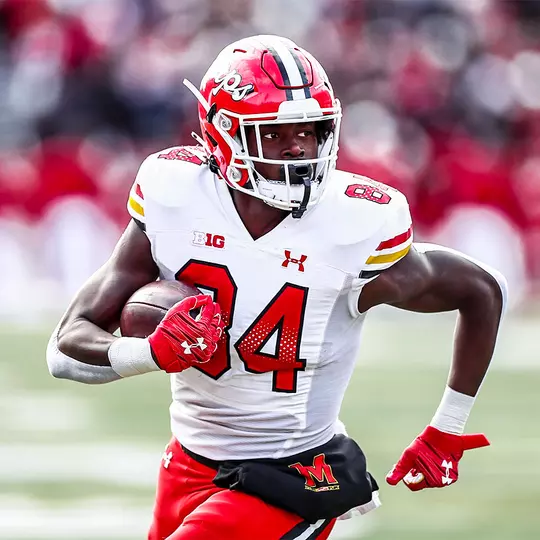
Together, they had all achieved one of their many goals on the season. More importantly, they have laid the foundation for something even more special to come in its wake. The bowl game means the team gets more time to practice together and develop younger players like running back Colby McDonald and linebacker Demeioun Robinson, who have taken on larger roles the past few weeks.
The image of Locksley and his players taking a group photo is one of jubilation but also hope. The hope is that this is the start of Maryland football becoming the program that Locksley envisions it can be.
“I came here to build a program that our former players, that all of our fans could be really, really proud of,” Locksley said. “This is just one step. We talked about taking the next step, and that being bowls. The next step for us is to build upon what we've established - the culture, the identity. We have young players, and I think it gives us a bright future. I love the way our seniors are leaving a foundation of what leadership looks like as we bring in the right kind of players. I told our veteran players this was going to be their Christmas card. This [win] was going to be my Christmas gift to them, and they came up here and took the victory. We go stand on the goalposts, get the scoreboard in it and then send them home with a nice victory picture. This is the end of our ‘21 season and also gives us the start to ‘22.”