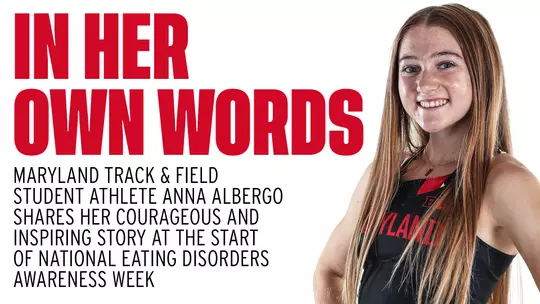
Maryland Track & Field student athlete Anna Albergo shares her courageous and inspiring story at the start of national Eating Disorders Awareness Week
Anna Albergo, Maryland Cross Country Freshman
2/27/2023
Each year, the National Eating Disorders Association (NEDA) dedicates one week in late February to raising awareness about eating disorders, a detrimental condition to which college athletes are highly susceptible. In honor of NEDA Week this year, my team's nutritionist, Paula Karamihas, encouraged me to share my experiences battling the disease, hoping to provide insight to other athletes here at Maryland. NEDA Week means a lot to me because it is when I realized that I had an eating disorder after a long period of denial. Now that I am a year into recovery, I'm grateful for this opportunity to contribute to the awareness, education, and inspiration that NEDA Week provides.
I began to take running competitively seriously during the fall of my freshman year of high school. Starting that spring, I began to develop an unhealthy relationship with eating. I began associating a thinner body shape, and lower weight with speed, a concept I now know is false and rooted in eating disorder thoughts. I went through periods of disordered eating, typically around big competitions and stressful situations, and then periods of healthy eating for about two and a half years.
Beginning the summer before my senior year of high school, things started to spiral out of control without me realizing it. I started engaging in eating disorder behaviors more frequently and based my mood and self-worth on how I looked. I was willing to do destructive things to make myself look a certain way. I wanted more than anything to have a good senior season and commit to a good college, and my eating disorder convinced me that eating a certain way would help me achieve that. Since my self-esteem was based on how I looked, I falsely thought I felt happier. I was caught in what I can best describe as a trap or a vicious cycle.
In November, I committed to the University of Maryland for cross country and track and was eager to continue progressing as I had been all fall. However, after that point, my body began seriously suffering the consequences of my unhealthy behaviors. I didn't race as well as I could have at my last two meets of the cross country season, but I had no idea that it was related to my unhealthy behaviors, which I believed to be healthy at the time.
My health continued to worsen throughout the winter. My hair was falling out, I was constantly cold, I couldn't sleep through the night, my nails were brittle, and I had low motivation for school and couldn't focus, causing my grades to slip. I was also struggling with a lot of anxiety surrounding food.


At the end of the indoor season, after my race at the state meet, my coach suggested I get my blood tested since I was not performing up to my capabilities. At the same meet, I talked about my race to another coach I was close with, and she asked about my eating patterns. It was not until this moment that I considered that my eating patterns contributed to my poor performance and overall feelings of sickness.
My blood test revealed anemia and numerous nutritional deficiencies. I had low iron, blood sugar, vitamin D, and lower estrogen than was healthy for my body. The timing of the blood test aligned with NEDA week, which opened my eyes to what was actually happening to me. When I saw my doctor after getting that blood test, I described to her my eating behaviors, and she officially diagnosed me with an eating disorder. She referred me to a nutritionist and therapist, which marked the start of my treatment.
When I first met with my therapist, it was an eye-opening experience for me. The healthy part of my mind knew I was sick, but the eating disorder part of my brain questioned why I was even there for months. She presented me with three options for my treatment: to go to a partial hospitalization program, an intensive outpatient program, or an at-home family-based version of the treatment. I chose to do the family-based model so that I could finish my senior year of school and track. I'm grateful that I was given the option to keep running, but I continued to struggle and ultimately didn't finish my senior season.
At the beginning of the summer, I decided to go to a higher level of care, knowing that I probably wouldn't make enough progress at home to go to college and be successful in the fall. Going to treatment was a hard decision for me, partly because of the stigma that comes around it, but it ended up being a beneficial experience for me.

One of the first things I was taught to do in treatment was to separate the part of my mind that was still me and the part of my mind that was taken over by the eating disorder. That helped me to realize when the eating disorder was talking, when I was talking, when the eating disorder was in control, or when I was in control. The eating disorder part of my mind convinced me that it was perfectly acceptable to do harmful things. It didn't want what was best for me; it wanted to achieve my version of an ideal body. I constantly felt like I was in an abusive, manipulative relationship between my mind and body, an analogy that I feel accurately captures what it feels like to be controlled by an eating disorder.
I progressed a lot in my recovery over the summer and got discharged three days before I was set to move to UMD. However, recovery made the transition to college difficult for me; I was transitioning from a higher level of care and back to outpatient at the same time as I was transitioning to being a freshman in college.
I arrived to the team eager to compete, but it quickly became apparent that my body wasn't ready yet. It was still difficult for me to complete runs and workouts. I was always tired, dizzy, and cold while running, and I got two stress fractures and a stress reaction in my foot, all leading my coach and me to decide to medically redshirt my first two seasons.
A year after my diagnosis, I'm still actively working on my recovery. I'm learning how to be truly happy without my eating disorder taking up so much time and mental space. In addition to my story, I wanted to share some insights I've learned throughout the past year.


The stigma around mental health in general, not just about eating disorders, is real. It increased the guilt that came with getting treatment and the shame surrounding telling significant people in my life about my condition. I held back on telling my high school and college coaches for as long as possible, even though that was not in my best interest.
A common misconception about eating disorders is that they only cause people to look better, something I definitely thought as I began to engage in unhealthy behaviors. It's what makes them so appealing and addictive. But how you feel about what you see on the outside does not accurately reflect the damage done on the inside. Eating disorders cause so many physical, mental, and emotional issues that persist into recovery. In my case, I experienced anxiety, depression, anemia, stomach issues, other nutritional deficiencies, and challenges in my interpersonal relationships. I never believed wanting to change my body shape would complicate so many other matters. I thought it would make me eternally happy, but it did the opposite- it destroyed my physical, emotional, and mental well-being.
If I've learned anything over the past year, it is that recovery is possible and 100% worth it. No one deserves to live a life controlled by mental illness. Recovery is about silencing the voice of the eating disorder and slowly gaining back control of your life, figuring out who you really are in the process.

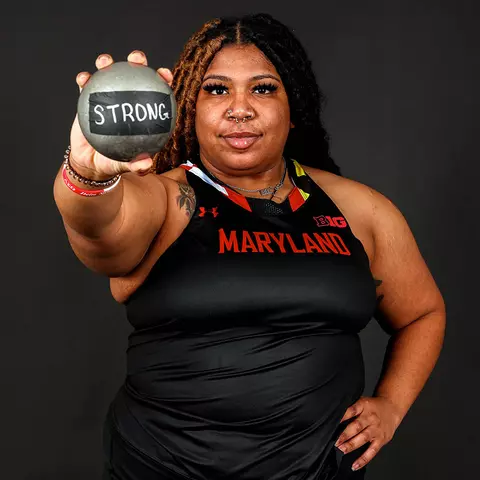
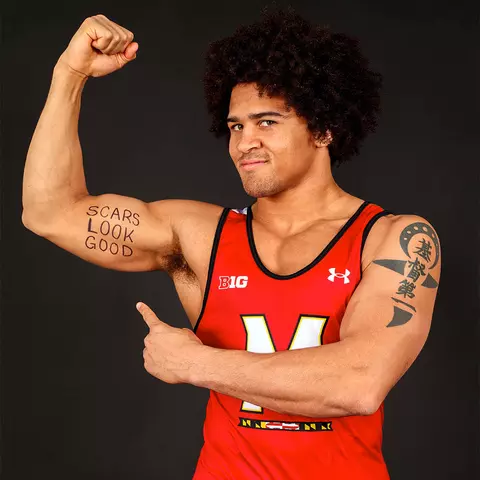
In addition to Anna, these Terps wanted to bring attention to National Eating Disorder Awareness Week and the impact it has on body image. They selected a word that best represented them feature here:
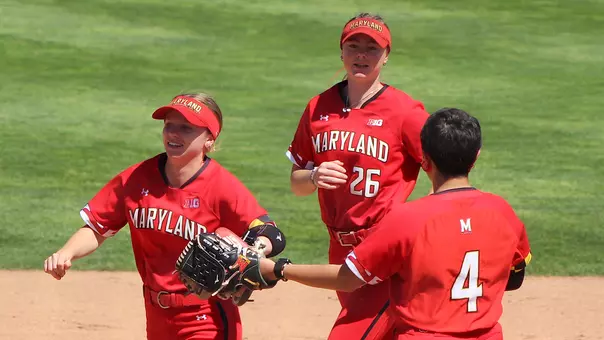
Taylor Liguori, Softball - Powerful
Jayla Bynum, Track & Field - Strong
Ava Morales, Soccer - Small but Quick
Jaron Smith, Wrestling - Scars Look Good

There are many resources and people out there that genuinely want the best for you and your health. In my experience, showing up for yourself, surrounding yourself with positivity, and recognizing that small successes are big wins is the ticket out of mental illness and into a life where you are your true self: free from living in constant fear of food and body image.
For me, NEDA Week has been life-changing, and it can be for so many others if we continue to be vulnerable, share resources, and reflect on our own experiences with food and body image. No matter if you have an eating disorder or not, NEDA Week is an opportunity to reflect on diet culture and educate yourself about eating disorders. Diet culture and the concept of the ideal body are the roots of many eating disorders. It's become a central part of society that people contribute to without even knowing they are making a negative impact.
It's important for everyone to take time this week to consider how they contribute to the concept of food and body image and whether that is positive or negative. Another thing to consider doing this week is educating yourself about the disease so that you can recognize unhealthy behaviors and treat them before they escalate. Unhealthy behaviors are normalized today, making them go unnoticed. If you take time to learn about what is truly unhealthy, you can more easily recognize those behaviors in yourself and those around you.
I hope you take the opportunity to make changes within yourself and your community this week. Please know that there are resources if you or someone you know is struggling.