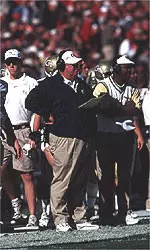
Friedgen's Roots Run Deep
12/27/2000 7:00:00 AM | Football
Dec. 27, 2000
Click here to read the story at washingtonpost.com
By Rachel Alexander
The Washington Post
The typewriter was a big, black hulk of a thing. Gloria Friedgen was supposed to be using it to write her graduate school thesis, but instead she sat hunched in the corner of an apartment on the edge of the University of Maryland campus, typing more than 120 letters for her new husband, Ralph.
They were letters pleading for a job, letters that all began: "Football is my life." They were letters that were met with rejections.
That was more than 30 years ago and just a few miles from the office where Ralph, 53, sits as the Terrapins' new head coach. Sometimes it feels like those letters were typed in another lifetime. Sometimes it feels like they were slipped into the mailbox just yesterday. After all, much of Friedgen's professional life has been spent looking for a job that never seemed to be looking for him.
Who knew that to find it, he would end up where he started?
"I don't know how many times I walked up and down that hill outside the stadium in my seven years of being a student here, then 30 years go by and you're driving down that same hill all of the sudden," Friedgen said on a recent morning, nodding toward the predawn black outside his new window in the Terrapins' football building.
"I was showing a coach the campus the other day, and I saw the place where my parents dropped me off when I was a freshman. It's an immediate flashback. It's like my mother's right there, crying as she sends me off."
No one is crying for Friedgen now. Instead, a kind of optimism that College Park hasn't seen in years is kindling a feeling even more palpably hopeful than when Friedgen's highly touted predecessor, Ron Vanderlinden, took the head-coaching job in 1996. Everywhere Friedgen goes, students greet him with chirps of "Hi, Coach." After he leaves alumni lunches, boosters poke each other and nod, wordlessly declaring that even though Maryland somehow has been left out of this week's bowl frenzy once again, someone has arrived to set things right.
In fact, confidence in Friedgen is so high that no one else seems to have been seriously considered for the job. Athletic Director Debbie Yow contacted Friedgen's agent hours after firing Vanderlinden and a few days later flew to Atlanta, where Friedgen had long been working as Georgia Tech's offensive coordinator.
When she arrived, the two talked football, philosophy and administrative commitment, getting so wrapped up in conversation that Yow almost missed her flight back to Maryland.
"It was obvious he had a tremendous work ethic and passion for Maryland," said Yow, who formally interviewed one other candidate. "He's been here before, so the learning curve is much improved. He needs no campus map, for one, and he understands the things that are intangible -- a working knowledge and perspective of the institution and the history of the football program."
Midway through that first meeting, Yow leaned over to Friedgen and whispered, "You're my guy." Friedgen was shocked. First, he was only about a third of the way through his pitch. Second, well, no one had ever said that to him before.
Like Father . . . The last time Ralph Friedgen was a star was probably 36 years ago, when he was the high school quarterback for the team his father coached in Harrison, N.Y. Also named Ralph, Friedgen's father was an enormous figure in local football circles, huge in stature -- weighing more than 300 pounds -- and in reputation.
He was respected by all, feared by some and loved by his players, especially his son, who could never quite get over the fact that his dad had been a college teammate of Vince Lombardi's at Fordham. Young Ralph was a quick study -- his father quizzed him on formations, plays and strategy -- and as a senior led a Harrison team that averaged about 44 points a game to an undefeated season.
The performance earned Friedgen a scholarship to Maryland, but once he got to College Park, he had a harder time finding his niche with the Terrapins. Caught in a turbulent stretch of three head coaches in five years, Friedgen first played on special teams, then at fullback, then at linebacker, then at offensive guard.
Plans for his professional life were blurring as well -- Friedgen had figured he would become a teacher, like his parents, but during a stint in a student teaching program, he found himself bored. Coaching seemed more fun, so he went back to Maryland for a master's degree in psychology and began helping out with the Terrapins' freshman squad as a volunteer.
It was while he was out on the field with the freshmen that he first saw Gloria Spina.
"She was walking around up by Cole Field House, and she had really good legs so I asked her for a cup of coffee at the student union," Friedgen recalls, smiling. "At this time I weighed about 250 pounds, so she sized me up pretty quickly and realized that the way to my heart was through my stomach. She volunteered to cook a meal for me and my roommate -- I think it was lasagna -- and we've been together ever since."
After they were married, Gloria added typing to her duties, first transcribing Friedgen's thesis and then moving on to the letters. With his coaching pedigree, a recommendation from then-Maryland coach Roy Lester and the hard work he had put in, Friedgen figured someone would hire him.
More than 120 letters went out to Division I head coaches and the Friedgens sent another 40 or so to high school coaches. Most answers were polite rejections. Some were more blunt -- Alabama's Bear Bryant wrote "I've already got too many coaches" -- and others never came at all.
"It was hard," Gloria remembers. "There was just -- nothing."
Friedgen had no choice but to continue volunteering with the Terrapins. But in 1972, he caught a break when Jerry Claiborne was named coach. Claiborne brought with him a promising young assistant named Bobby Ross, and the two decided to hire Friedgen at $150 a month to help coach Maryland's linebackers.
Friedgen was thrilled, although it wasn't exactly how he dreamed of getting his first paying coaching job. Even a year later, when Ross was under consideration for the head coaching position at The Citadel, Friedgen was still wary, looking on skeptically as Ross told him and fellow graduate assistant Frank Beamer that they could come along as assistants. Scarred by his rejections, Friedgen noted, "I told him to call me when he actually got the job, and we'd talk."
Ross did get the job, and he did bring along Friedgen, who became the defensive line coach and then the offensive coordinator, and Beamer, who went on to lead a football resurrection at Virginia Tech. Nine years later, when Ross was hired to succeed Claiborne at College Park, he called on Friedgen again.
Over the next five years, the Terrapins embarked on one of their most successful stretches with three ACC championships, four bowl appearances, a 39-19-1 record and a number of alumni who went on to star in the NFL.
"Ralph was a key to all of that -- he was just very straightforward, very honest and the kids responded to him," Beamer said. "With him, what you see is exactly what you get."
When Ross moved on to Georgia Tech, Friedgen followed, and so did success. The Yellow Jackets won a national championship after an 11-0-1 season in 1990, and in 1992, when Ross moved on to the San Diego Chargers, Friedgen thought his big chance had come.
In the past, every time Friedgen had expressed interest in head coaching jobs at other schools, he was told not to bother even applying. But this time, after 23 years as an assistant, he was granted his first formal interview -- for Ross's Georgia Tech job. He walked out of the interview feeling great about his chances. The job went to Bill Lewis.
"I never promoted myself over the years, and because of that, a lot of good things passed me by," Friedgen said. "All of the sudden, I was 45 years old, and all my buddies had been head coaches for 10 years. You get really discouraged."
Rejections There has long been no doubt among his peers that Ralph Friedgen deserved to be a head coach. He is smart, determined and a tremendous worker. By last year he was making more money than any other college coordinator in the country, a perk that seemed only appropriate for the man who won the 1999 Frank Broyles award for the nation's top college assistant coach.
Apparently, though, there were plenty of people who didn't think Friedgen deserved to be a head coach. In his decades coaching college football, Friedgen had been passed over by dozens of athletic directors, including Yow when she was vetting the job that went to Vanderlinden. In fact, Friedgen had expressed interest in the Maryland job the previous two times it had been open, and both times he was denied even an interview.
He tried for Duke. North Carolina. N.C. State.
"Duke never wrote me back, Clemson never wrote me back -- I've applied for half the jobs in this league," Friedgen said. "Then you hear all the reasons people are saying you didn't get it -- your looks, your weight, your demeanor, all sorts of things that shouldn't have an impact on football. But there I was, not even getting a 'Thank you for your interest.' "
Friedgen jokes about his weight, something Papa Ralph passed down to him along with all those complex offensive schemes, although it's clear that it has hurt more than just his health. With recruiting and alumni hand-shaking nearly as important as coaching, Friedgen has suffered by comparison to other coaches, many of whom look like preppy drill sergeants.
Even a stint with San Diego under Ross didn't seem to change his luck. Friedgen had been with the Chargers for three years when they went to the Super Bowl, and he stayed another two before Ross moved on to the Detroit Lions. But once again, no one wanted to talk to him about a head coaching job, and he returned to the offensive coordinator position at Georgia Tech, slowly resigning himself to his situation.
For a while, Friedgen put off building a house on a lakefront parcel of land that conjoins property O'Leary and Beamer also own in Georgia. Last year, he decided it was time. "I was really in a position to just stay at Georgia Tech the rest of my life," he said. "I figured no one really wanted me."
Considering how well this season has gone for the Yellow Jackets, that might not have been such a bad thing. After not being projected to do anything particularly special, the team finished with a 9-2 record, a No. 15 ranking and a Peach Bowl berth.
Moreover, much of the team's success was credited to Friedgen, who guided junior quarterback George Godsey to a stellar season. But, as Friedgen likes to joke, just when you get comfortable with something, it changes. Shortly after the finishing touches were put on the lake house, the Maryland job opened. And unlike all those other long afternoons of waiting for phone calls that never came, this time Friedgen's line was the first to ring.
"A lot of the football alumni were disappointed they didn't interview him four years ago, but when they went out and got him this time, it really put a fire into everyone," said former Maryland and NFL standout Boomer Esiason, who is leading a fundraising drive to get Friedgen new computer equipment. "He's tied to the university in one of its most successful periods, and he knows what it takes to get the program back there again."
Friedgen has met with the team to talk about his vision for the next few years and has spoken with most of the players. He has even seen some more often than others as he has instilled an academic program that involves players running up and down the stadium steps at 6 a.m. if they miss a study hall or a tutoring session.
In the beginning, about five or six players were skipping out on their class work, but by last week the number was down to one, a player to whom Friedgen said, "you're going to be in great shape when you flunk out of here."
Friedgen arrives at the football building around 5:45 a.m. each day, then spends the next 14 hours watching tapes, meeting with his staff and trying to nail down Maryland's next recruiting class in a barren office. Friedgen said he knows he has to put up some plaques and pictures of his own, but he's a little busy right now, especially with all the letters that are coming in.
He has received about 75, all from young coaches looking for work. He tries to answer them as completely and nicely as he can -- after all, he knows what it's like to fold that piece of paper, stuff it into an envelope and watch your crushed dreams come back by return post. Still, he also knows that it's never as easy as popping something in the mail. Sometimes you have to travel a long way to find your way home.
"When Debbie first told me she wanted to hire me, I didn't know what to say because I had so many more plans I wanted to explain to her," Friedgen said. "You have to understand, I've been working on this for 30 years. Now that I have this chance, I'm going to have a lot to say."