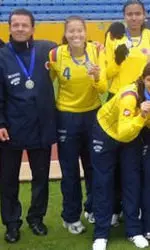
Former Terp, Nataly Arias, Prepares For World Cup
6/3/2011 8:00:00 AM | Women's Soccer
June 3, 2011
COLLEGE PARK, MD. - Former University of Maryland women's soccer player Nataly Arias earned a spot on the Colombian National Team and will be competing in the 2011 Women's World Cup, which will take place from June 26-July 17 in Germany.
Arias' former coach at Maryland, Brian Pensky connected with Arias recently and the native of Alexandria, Va., answered some questions, including how it will feel when Colombia lines up against the US National Team in pool play on July 2.
"Everyone is just so pleased for Nataly," said Pensky. "She loves this game, and to have this type of opportunity on the international stage, is indescribable. In some ways, I am not surprised to see Nataly playing in the back. As her career evolved at Maryland, some of her greatest assets became her aerial game and overall physicality. And as Nataly sort of alludes to in this Q and A, who would have thought, back when she was a 16 year-old technical little central midfielder that her defining qualities would be what they are today. And for their national team, the beauty of having a skillful right back like Nataly of course is that she gives her team a tremendous attacking element as well."
Question: Nataly, tell us about your journey towards earning a spot on the Colombian women's national team. Having parents who are Colombian and Venezuelan, yet living your entire life in the United States, how did all of this come about?
Arias: Around February 2010, my father approached me about the possibility of trying out for either the Venezuelan or Colombian national teams. Because he played professionally in Venezuela he had connections that helped to get me in contact with the national team coaches. Also he informed me that Colombia would be competing in the U20 Women's World Cup in March 2010 and that it would be a good opportunity to see the players in action. After watching Colombia play in the U20 Women's World Cup, I was even more excited at the prospect of getting a tryout. Venezuela did not give me the opportunity to tryout, but thankfully, Colombia gave me a 10-day tryout at the end of August 2010. Of course, during this time, I had to re-learn Spanish. I spoke Spanish as a child, but I had not used it daily and I was forced to learn fast! The girls loved to hear me speak English and they were great at teaching me Spanish. Luckily by the end of August, the coaching staff liked me enough to ask me back to camp in September and by mid October 2010, I had earned a spot on the final roster for qualifiers in Ecuador. Thankfully the rest is history ...
Q: Tell us about the South American women's championships this past fall, where you guys earned Colombia's 1st-ever birth to a World Cup. How was that experience?
A: The Women's World Cup qualifier was an unbelievable experience! The tournament (COPA AMERICA) was held in Ecuador and every game was in a different city. The chance to experience another country's people and culture was extremely exciting, and to play against such quality teams as Brazil, Argentina, Paraguay and the rest of the South American countries, while personally seeing how far the women's game has come, was absolutely thrilling! To have had the opportunity to play against Brazil and compete against some of the best players in the world, such as Marta, was not only humbling, but amazing! Wow, to be on the same field playing against Marta was a dream come true. To see so many people be so interested in our competition and be true fans of the game, and chanting "Colombia, Colombia, Colombia" was overwhelming and encouraging to see. After beating Argentina and realizing what we had achieved as a team and for our country it was unreal. I was overwhelmed with emotion of what we had accomplished for ourselves. I am so thankful for that experience at the qualifiers, and I consider it one of the best moments in my soccer career. I am also happy to say that the future of the women's game in South America is very bright and full of possibilities.
Q: Just under one month away from Germany 2011, how are your team's preparations coming along? How, and where, are you guys preparing?
A: Our preparation is going very well, and the camps and sessions have been extremely challenging and require a lot focus and a positive physical attitude. All of our camps have taken place in Bogota, Colombia and preparations began in January. Basically we have 14-20 day training camps, where we alternate between two-a-days and one-a-day sessions. Our focus has been technical work, tactical work, and fitness.
Q: How do you feel about being in the same group as the USA? And how do you feel about your group in general?
A: Growing up a US National Team fan, and having made the National Pool as a youth player, it is thrilling to have the USA in our group. "In order to be the best, you have to play and beat the best"; therefore, we welcome the challenge and look forward to playing the USA and are preparing for that tough task ahead. Most of all, for me, it will be an honor to represent Colombia and be on the same field as the USA - one of the best women's team in the world. As many people have stated, we are in "the group of death" and we believe that to be true as well. Needless to say, our group is extremely strong boasting the #1, #4, and #6 ranked teams in the world respectively. Colombian players have accepted the challenge and are very excited to compete in such a strong group. We will approach every game as a final, and I believe that philosophy will help us be successful. We are there to compete, and we will do so in every game.
Q: How would you describe Colombia's style of play? You grew up playing your entire life in the USA ... what are the differences, or similarities, between soccer in Colombia and soccer in the United States?
A: Colombia's style of play is very possession oriented and the players are extremely technical. Colombian players are very savvy and read the game very well. The biggest difference between soccer in the US and soccer in Colombia is the importance put on technical ability and playing fast. In the US we have more athletic prowess so we rely on that more tWAn technical work; where as in Colombia, the players are not as athletically gifted, so playing fast, and technical proficiency in all aspects of the game, is the standard. The similarities are possession style of play and the attacking mentality.
Q: How has your game evolved as a player throughout this experience? What strengths do you feel you bring to your national team?
A: I believe my game has evolved a lot since I have had to embrace defending. I have been a center midfielder all my life, both in youth and in college, and I am now a right outside back. Two completely different positions tactically, but I have really enjoyed the challenge and have embraced all aspects of it. The change in position has helped me grow as a player and it has been exciting, and overwhelming, at times. I consider myself to be more of a complete player now and I have versatility to my game now which I did not have in the past. I have developed tactically as well to learn a completely different position and master aspects of it and use my ability to enhance my team's presence on both sides of the ball. The strengths I bring to this national team are my heading ability and my ability to challenge 50/50 balls in the air. My long ball service has also been a change to their style of play here since most of our game is short, quick passes. Due to my height and maturity in the game, I bring size and strength, and also a disciplined approach to training. I was taught by my father very early on "to practice the way you want to play" in order to challenge yourself and get better every day, and I believe I have brought that mentality here and it has helped me and my teammates to grow.
Q: And lastly, which family members and friends of yours will be in Germany watching and supporting you this summer?
A: I am so fortunate to say that my wonderful mother, Gladys Pena-Arias, and my aunt, Darla Portillo, President and CEO of DP Technology Services, Inc., (DPTS), husband, plus four cousins and their immediate families, will be coming to Germany to watch me play. The one sadness that I have is that the one person who passed to me, "the love of game" and is responsible for everything that I have accomplished in soccer, my father, Fernando Arias, will not be there. Even though he will not be there, I am incredibly thankful that I will have the opportunity to share this experience with a lot of my family!! Everyone else that cannot make the trip to Europe, including my brother, Jonathan Arias, my biggest fan, will be watching it on TV, so no one will miss out. I am so lucky to have such an amazing family that supports me and I feed off of all of that positive energy. God has blessed me beyond my expectations and I am truly enjoying this experience every step of the way.