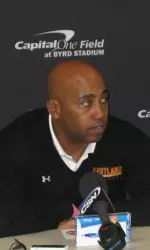
Coordinators Visit with Media
2/9/2012 7:00:00 AM | Football
Feb. 9, 2012
LIKE! Maryland Football on Facebook
LIKE! Maryland Athletics on Facebook

COLLEGE PARK, Md. - Head coach Randy Edsall hired a pair of new coordinators in the offseason. Mike Locksley was brought on board as the offensive coordinator/quarterbacks coach in December and Brian Stewart joined the staff as defensive coordinator/secondary coach last month.
With recruiting the primary focus after the hiring of each coach, Locksley and Stewart had a chance to visit with the media in person for the first time Wednesday in the Gossett Football Team House.
Offensive Coordinator/QB Coach Mike Locksley
On the origins of his offense:
"It's funny that you ask because we are in the process of installing the system with the coaches and the first day I met with the offensive staff I kind of gave them the background on this offense. It's a combination of a one-back passing attack, the spread running game, as well as my pro-style background from my years with Ralph [Friedgen]. As it has continued to grow it's the same offense from a vernacular standpoint that we ran at Florida. Rex Grossman played in this offense [and] Chris Leak played in this system. At Illinois, Tim Brasic and then Juice Williams, and then obviously the next year we had two or three different quarterbacks playing [in the system] that all had different skill sets. So that's why I tell people that it's a multiple pro-style. When people hear spread the first thing they think is throwing the ball. Well there's a lot of different ways to run spread mechanics. You've got the Rich Rodriguez-type spread where the quarterback is the focal point of the run game. You've got the Mike Leach-type spreads where they throw it 70 times a game. And then you have the in between and I would venture to say if you watched this offense and its basis mostly at Illinois under my calling the plays there, it was in the middle. We led the Big Ten in running the ball. We had running backs like Pierre Thomas and Rashard Mendenhall and drop back quarterbacks. And then we progressed to a guy like Juice Williams who, by my last year, led the Big Ten in passing. So, [the system] is very multiple very multiple, very flexible and the big key for me is finding and evaluating the playmakers in our system and then shaping it to do what our players allow us to do on offense."
On his impact on this recruiting class:
"The big thing about recruiting is that it's a team effort. I think the staff did a tremendous job. I walked in to the door and we had 23 or 24 guys committed. For me, it was just a matter of assuring the offensive players that we were committed to doing things on offense that would allow them to be the players that we recruited them to be. I've been able to assist on a lot of things. I've got to give a lot of credit to the coaches that were here doing all the recruiting. They kind of set the tempo for some of the guys that I've been able to assist or help with."
On the local talent:
"I don't hide very often that I have an affinity for this area and the talent because where ever I've been I've always recruited it. I really believe that there is a lot of talent in this area. Most of the talent you see here typically has a lot of upside. I've recruited the state of Texas quite a bit in my career, and one thing about players from Texas is usually what you see is what you get but I'm a big believer in the D.C/Maryland/Virginia region that a lot of the players that come out still have a big upside. If you look back at the success in my prior stop here, if you look down at the roster of the starter in the Orange Bowl there were quite a few kids from this area that were starters or major contributors. I know Randy is committed to recruiting this area, having this be the nucleus and then working outwards."
On selling Maryland after 2-10 season:
"I think the big thing is that regardless of record, a guy is still going to go to school usually within a three- to -four-hour radius of home. The second factor is usually playing time, and when you're coming from a 2-10 season, typically there will be some vacancies for early playing time because obviously you didn't get the job done and there will be great competition. To me those are the two to three things that generated it and then its just about relationships and being able to have a tie or find connection and get a player that you couldn't get coming off a two and ten season. For me this isn't new, we've done some of this before at other places I've been where you've had to recruit coming off a losing season. Its tough, but you've got to but the work in and make sure your going after the kind of right kids and doing things the right way."
On getting players on the roster to buy in:
"I think that recruiting starts with recruiting the guys in your program because they're your allies, they're the guys that are selling your program. Having gone through some of what we are going through now at a prior stop; change is tough. If you look at any place where there has been a change at head coach, there is typically a little fall off that takes place. Use my time at Florida as an example. We had built a pretty good team and then we were let go and a great coach came in Urban [Meyer]. They struggled year one with Urban, they had some attrition, they had some turnover and then the second year it came back and they won the national championship. To me change is tough, especially with 18 and 22 year olds, but our players have been resilient. I know Coach [Edsall] has made some necessary changes in the program to make it better. It starts with relationships, I can't emphasize that enough. The relationships you have with your players are what makes them go out and play hard for us and I know Coach and our staff are committed to developing those relationships."
On this situation reminding you of another one:
"I've never gone into a situation where I was the only coach coming in on the offensive side of the ball. Those are usually tough, most of the time I have been a hold over where everybody was kind of new coming in. This is different for me in that being the only guy coming in on the offensive end, implementing the system with some guys that may have done things a different way last year, that's been a challenge. From the standpoint of terminology, I've tried to make sure that if I've had to do any relearning to put my system in and change my verbiage that I usually call to keep it the same for the players, then I'll put the pressure on myself to learn the new verbiage so that part of it has been a little different and a little more challenging."
On this job being an opportunity to erase what happened at New Mexico:
"I'm not into try and prove or discount anything that's written because the people that have known Mike Locksley for the 23 years of my coaching, it would be tough to really believe any of the things that are written or said. I had a lot of options prior to coming to Maryland and we came here because as a family, we thought this was the best situation for us. I was excited to come and work with Randy and I was excited to be able run an offense again. When you're a head coach, I called the plays maybe six games in, two years as a head coach so you give up a lot of the day to day stuff with going along with it. For me, it's a welcome to be back to having relationships with the quarterbacks, with the offense, implementing, installing, calling plays. That's what coaching's about, when you get in that big chair, there are a lot of things off the field that you have to deal with that take away from the pure football part of it. I'm excited about the pure football part of it."
Defensive Coordinator/DB Coach Brian Stewart
On his defense and the type of scheme he will run:
"I started the 3-4(defense) in Dom Capers system with the Houston Texans. That was a left and right system, everybody played left, and everybody played right. So there was a left outside backer, left end, right outside backer, right end. The only people that flopped were the inside backers, the strong backer went to the strong side, the weak backer went to the weak side. With Wade Phillips, there was no left and right. The ends were left and right, and then the backers. The WILL was always to the open side and the SAM was always to the strong side. Those were the two influences that I draw from as a play caller in this defense. Both have been known to be pressure defenses and when we talk about pressure defense, we're not talking about blitzing every play, that's not what pressure is. Pressure is when the receivers get ready to catch the balls, the DBs are in a place where they can contest every catch. Pressure is when the linebackers are showing at the line scrimmage and the quarterback doesn't know out of those seven guys at the line of scrimmage who is coming and who is not. That's kind of how I got to where I am defensively with the three four defense."
On players fitting the scheme:
"I think that any time you're in a situation like I am coming in you try and look at the skill set of the players and more than the scheme they were playing in. I like to see them playing against Florida State, Clemson, Georgia Tech and West Virginia and then look at the skill set of the players that are coming back. That's what I do when I'm evaluating tape. I look at it everyday, over and over, so by spring ball I should know the skill sets of the players on the field."
On being equipped to defend the spread:
"I had the opportunity to have the best of both worlds. In the NFL it's a two-back system predominantly and I had a chance to be there. In Conference USA which was the spread, chuck and duck, I had a chance to be in the chuck and duck system. That being the case, some of the base principles coverage wise and some of the runs they have, we'll be clean on and it will be easier for me to teach the assistant coaches how we want to play certain things."
On setting the defense back no track after a tough season:
"I never look at [conference and NCAA] rankings. If you get caught up in the rankings, you will get discouraged or you'll start patting yourself on the back. First of all, you've got to believe in your system, you look at the people who are going to play in your system and the guys that will teach your system. If you can get those things to jive, then you've got a chance to be successful and that's how I look at it."
On installing the defense by the end of the spring:
"The first few spring practices we throw a lot of stuff at them. In the install, they're in shorts so they don't have the conflict of learning the defense as well as hitting. So those first few practice are pivotal to see how they learn, how fast they learn, how we're teaching it and seeing what we have to take step by step versus some things that are just understood."
On the 3-4 being your favorite scheme:
"I think that the 3-4 helps your team special teams wise, because instead of having four D-Lineman, you have to carry at least eight. You have two extra backers who can help run down on kickoffs, so your special teams become faster and more athletic. As far as defensively, 3-4 lets me be a chameleon, I could be in any look I want. I can look like I'm in stack, in under, in bear and that allows me to put pressure on the offense by being in and pressure. Remember pressure does two things, it creates diamonds and busted pipes and hopefully we'll bust some pipes."