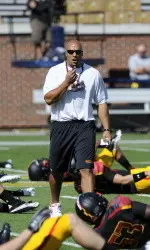
Wilson Raises the Bar with Offseason Program
4/2/2012 8:00:00 AM | Football
April 2, 2012
By Keith Sneddon, Maryland Athletics Media Relations
COLLEGE PARK, Md. - Long before the Maryland Terrapins hit the football field for their first practice of the spring, preparation began for the 2012 season.
Led by director of football strength and conditioning Drew Wilson, the Terps worked tirelessly in the weight room for the six weeks leading up to spring practice.
In order to increase competitiveness and leadership, head coach Randy Edsall, along with Wilson, implemented of a new, point-based training competition with the team.
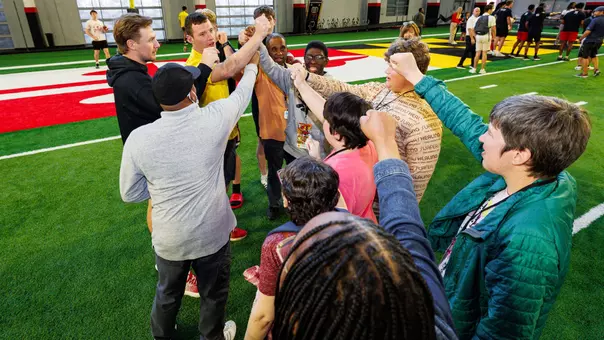
The squad has been broken up into eight teams of seven to eight players.
"We had a draft when we first got back from semester break at the first team meeting," Wilson said. "There are one offensive and one defensive captain for each team."
The captains, however, were not limited to seniors and upperclassmen. Sophomores Matt Robinson and Keith Bowers were selected to co-captain teams, as well as redshirt freshman Andrew Zeller.
"There are a lot of guys on the team with leadership qualities, and we didn't want to exclude anybody," Wilson said. "We felt, `let's put an offensive and defensive guy together.' We put guys together that, based on what we know, don't associate outside of what we do in the building. We want to see how these guys will interact."
The captains chose players for their teams based on a point system that not only rewarded athleticism and success on the field, but also hard work in the classroom.
"If you become a study-hall all-star -- which is through [assistant athletics director for academic support] Michael Harris -- that's plus-25," said Wilson "If their final grade's an A, that's plus-250, the final grade's B-plus it's 125 and final semester GPA's plus-500. We wanted to make it similar to being a general manager of a team. You've got to look at the whole approach, not just what you can do for them on the field."
Wilson, who is in his second season with Maryland, believes making academics a focus for the competition is important to strengthen players not only for football, but in character as well.
"The good thing is we added grades to it," Wilson said. "There are so many guys who think a C is good enough. We don't give points for C's. A [grade of] C is average. You want to be a great player in college football, you want to be an All-American, then you've got to be above that. That's what we preach to them all the time."
There is also a negative side to the system, with negative points in place to deter behavior. Skipping class, not meeting team weight, and missing workouts are all grounds for a "minus-10". Finishing a class with a D will net a minus-125, failing a class will lose your team 250 points, and a GPA below 2.0 for the semester is a 500-point deduction.
"We kept all the negative points very low to emphasize, hey, do the right thing," Wilson said. "You want to gain all these positive points for doing the right thing."
There's also a tier-system in place to reward the top finishing teams. The main focus of the program, however, is to create a competitive environment within the team that will translate over to the game situations in the fall.
"Our biggest thing here is making them competitive, especially in the fourth quarter," Wilson said. "We lost some games in the fourth quarter last year that we're unhappy about. Our biggest thing with coaching the guys is finish. Even if you mess up, finish, finish, finish, because you're not going to be perfect on every play."
Players, coaches and fans were disappointed in last season's 2-10 record, but if Wilson's outlook is any indicator, the team has taken it upon themselves to improve and make next year a memorable one -- for the right reasons.
"The biggest thing is, guys are picking each other up," Wilson said. "That's what we're trying to tell them. We have a game plan, but we want you to boost each other and hold each other accountable and coach each other to run this ship. The coaches don't always want to be the ones saying, `Hey, do this right, do that wrong.' When the guys start holding each other accountable, that's when things start clicking."