Terps Open First Spring Camp Under Locksley
3/26/2019 7:08:00 PM | Football
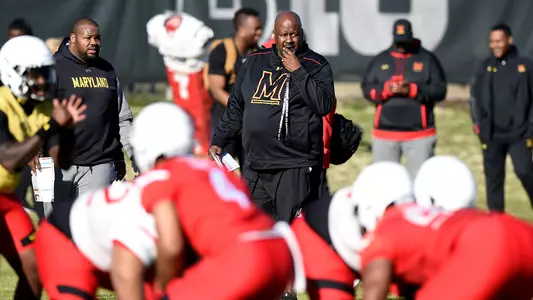
COLLEGE PARK, Md. - The Maryland football team kicked off spring practice on Tuesday, holding its first of 15 scheduled practices under first-year Head Coach Michael Locksley.
The Terps went through a fast-paced practice in helmets and shorts that lasted roughly two hours.
"We're excited to be able to get out here and start spring practice," said Locksley. "We've had a lot of preparation for day one in terms of the offseason conditioning program. I told the team, this starts the second phase of our program, which is spring ball. For us, we want to utilize spring practices to figure out who the playmakers are in all three phases for our team, and for us to get the base systems in place offensively, defensively, and special teams…I'm excited about the opportunity to start spring, I know the guys are ready to play football. Today was a good start."
The Terps return to the field on Thursday and spring camp will conclude with the annual Red-White Spring Game on Saturday, April 27.
Maryland opens its 2019 campaign on Saturday, August 31 at home against Howard. For more information on the season, follow @TerpsFootball on Twitter and Instagram, and for details on purchasing tickets, visit LockedIn2019.com.
Coach Locksely Quotes:
On his emotions coaching his first practice back at Maryland:
"It's like riding a bike. Day one practice. It's harder for a guy like me because I'm used to coaching a position. I'm used to having a side of the ball. Now, I've got to be aligned with the defense as well as the offense. I've got to take a big picture approach. Any time you start coaching all of them, it takes away from your ability to have that individual relationship with the players like you typically have as a position coach. It was a good start, I'm happy to be here and happy to be coaching these guys."
On the offensive line starters:
"We don't have starting spots; we have starting points. Those things will continue to change. We had a starting point for how to start a practice. At some point, somebody's going to have to go out there first. We had two groups going, we were two-spotting a lot of drills, that way we can get a lot of good video, a lot of good work, a lot of good reps for the guys. As coaches, we'll go back and watch the film from today and then that thing will fluctuate on a day-to-day basis as guys perform and show their abilities."
On how he feels about the offensive line:
"Well that's the tough part, because I really wasn't familiar with what we had. I felt coming into the spring, I really liked the offensive line. I felt like we had big, athletic guys that moved really well as we evaluated them through our offseason winter conditioning program. Those guys are really big, athletic guys. The numbers are a little thin - we're a little thin there - so we've had to adjust a little bit of how we would practice normally. Again, I think it's a good group. I like the core group of them that they're all big, athletic and have the ability to move."
On installing an offensive system:
"The big thing is to put the schemes in. From an execution standpoint, we'll put a premium on the execution part as we get into the scrimmaging. When we get into our day-to-day practice, techniques and fundamentals, we want to just install it, let those guys get on film to see exactly what it looks like to make corrections. Once we're able to get everybody here, including the guys that we signed or the guys that'll be here this summer, obviously we'll be able to evaluate it more then."
On if he plans to call plays:
"My plan going in is to not call plays. I feel really confident in [Offensive Coordinator] Scottie [Montgomery] as a play caller. I will be heavily involved in how we shape it from Sunday until the ball is kicked, but my intention is to let Scottie call it. We installed the system that we ran at Alabama, that I'm very familiar with. I'll use my expertise to help shape it, game plan it, and then Scottie will be the guy calling plays."
On evaluating Sean Savoy switching to corner:
"I didn't get a chance to see a lot of him. When we're in shorts, it's really hard. The big thing I was looking for today was our operation, our tempo, how we transition from drill-to-drill. We'll watch the film today, to be able to identify who guys are, to get a chance to see how some guys looked and moved around based on the system. He's been playing corner since he got here. We made the switch when he transferred in. One of the caveats for us is that we've got a lot of guys that play receiver for us right now. If you look at our roster numbers, we're a little depleted at corner. He's a guy that played corner and receiver in high school. When he came in, because of our needs at corner, that's where we brought him in as a transfer."
On the culture he's trying to instill into the program:
"I think the big thing is to set the standard for how we do business. Play with great discipline, be a team that doesn't beat itself. That's the first way you win; you learn to not beat yourself. Hold guys accountable. One of the things we preach quite a bit to our guys is that accountability runs horizontal, not vertical. We'll be a really good team when we're player-driven. As coaches, we've got to take the lead and be the driving force behind it as we install our program, but ultimately when we want to be really good as a program, the accountability and the leadership comes from within the group. We're continuing our search for leaders, we're trying to develop leaders within our program, and we'll take steps in that direction."
On accountability and the difference at programs with different levels of success:
"I definitely think talent plays a part. Talent is one thing, but talent doesn't take care of the football, talent doesn't contain the quarterback, or talent that drops interceptions, talent that fumbles negates the talent. It's always good and the teams that I've been on that have been successful, have had really good players obviously, but I also have been on those teams where they haven't allowed themselves to be their own worst enemies. The bad teams that I've been on typically have a bunch of turnovers, a lot of penalties, they play undisciplined. As we talked about earlier, that's one of the main things we've got to get instilled into the program to make sure that they understand if you want to be successful, you have to play with great discipline, and part of being disciplined is not beating yourself and making your opponent make the mistakes."
On the role that spring practice plays in recruiting:
"I think that's the great part about being here at Maryland as opposed to some of the other places I've been: that our location allows us to - within a 30-minute drive - you're close to around 5 million people. These recruits in this area have a tremendous opportunity to get on campus as early and as often and as much as they possibly can. To me, that's what forges the relationships in recruiting - getting them on campus and having spring practice - it affords them the opportunity to see the coaching, to see what type of coaches we have in our program, to see how we coach our kids, to see the interaction. To me, those are the things - when kids start making decisions - proximity to home is always really important, but I also think that having an opportunity to have a great relationship with the coaches that are going to be coaching them plays a huge part. With our location being where it is and being so close to so many players, the opportunity to get them over here as early and as often and as much as we can should help us."
On transfer LB Keandre Jones:
"One of the things that really jumps out from Keandre is having been around a winning program there at Ohio State, he understands the work that it takes to be successful. He's a kid that when you watch him throughout winter conditioning was first in all the drills and just brings tremendous effort. I like having a guy that comes from a winning program that has been a part of being successful, because when you start looking at the leadership from within, a guy that's seen and knows what it takes to be successful, being able to share his experiences and share what it takes to be successful. Hearing it from a peer as opposed to a coach adds a little bit more attention to it as far as the players on the program."
On RB Anthony McFarland:
"What I've seen out of all our guys right now is that all of the challenges and all the things that we put in front of them from a work ethic standpoint, I really like the energy of the team. I like the way that these guys have bought in. There hasn't been any pushback as a coaching staff coming in and I think a lot of it could be that there's previous relationships involved, but whether it's Anthony or any of these guys, they've all really bought in to what we're selling them and what it takes for us to have a successful program. Day one, shorts on, I know he's a big time player. I know he's made a bunch of plays around here last season, but we need to see it being a consistent point for us."
On if the interview process was different compared to what he's previously been though:
"It's been so long since the interview process took place. I just know this: this is the place I wanted to be. It worked out, it was a good fit, it was at the right time - timing is everything. Administration has been really supportive of me and has given us the resources that we need and are going to need to have and run a successful program. Compared to other interviews, I hate comparisons. People ask me to compare, I'm not real good at being able to do that."
The Terps went through a fast-paced practice in helmets and shorts that lasted roughly two hours.
"We're excited to be able to get out here and start spring practice," said Locksley. "We've had a lot of preparation for day one in terms of the offseason conditioning program. I told the team, this starts the second phase of our program, which is spring ball. For us, we want to utilize spring practices to figure out who the playmakers are in all three phases for our team, and for us to get the base systems in place offensively, defensively, and special teams…I'm excited about the opportunity to start spring, I know the guys are ready to play football. Today was a good start."
The Terps return to the field on Thursday and spring camp will conclude with the annual Red-White Spring Game on Saturday, April 27.
Maryland opens its 2019 campaign on Saturday, August 31 at home against Howard. For more information on the season, follow @TerpsFootball on Twitter and Instagram, and for details on purchasing tickets, visit LockedIn2019.com.
Coach Locksely Quotes:
On his emotions coaching his first practice back at Maryland:
"It's like riding a bike. Day one practice. It's harder for a guy like me because I'm used to coaching a position. I'm used to having a side of the ball. Now, I've got to be aligned with the defense as well as the offense. I've got to take a big picture approach. Any time you start coaching all of them, it takes away from your ability to have that individual relationship with the players like you typically have as a position coach. It was a good start, I'm happy to be here and happy to be coaching these guys."
On the offensive line starters:
"We don't have starting spots; we have starting points. Those things will continue to change. We had a starting point for how to start a practice. At some point, somebody's going to have to go out there first. We had two groups going, we were two-spotting a lot of drills, that way we can get a lot of good video, a lot of good work, a lot of good reps for the guys. As coaches, we'll go back and watch the film from today and then that thing will fluctuate on a day-to-day basis as guys perform and show their abilities."
On how he feels about the offensive line:
"Well that's the tough part, because I really wasn't familiar with what we had. I felt coming into the spring, I really liked the offensive line. I felt like we had big, athletic guys that moved really well as we evaluated them through our offseason winter conditioning program. Those guys are really big, athletic guys. The numbers are a little thin - we're a little thin there - so we've had to adjust a little bit of how we would practice normally. Again, I think it's a good group. I like the core group of them that they're all big, athletic and have the ability to move."
On installing an offensive system:
"The big thing is to put the schemes in. From an execution standpoint, we'll put a premium on the execution part as we get into the scrimmaging. When we get into our day-to-day practice, techniques and fundamentals, we want to just install it, let those guys get on film to see exactly what it looks like to make corrections. Once we're able to get everybody here, including the guys that we signed or the guys that'll be here this summer, obviously we'll be able to evaluate it more then."
On if he plans to call plays:
"My plan going in is to not call plays. I feel really confident in [Offensive Coordinator] Scottie [Montgomery] as a play caller. I will be heavily involved in how we shape it from Sunday until the ball is kicked, but my intention is to let Scottie call it. We installed the system that we ran at Alabama, that I'm very familiar with. I'll use my expertise to help shape it, game plan it, and then Scottie will be the guy calling plays."
On evaluating Sean Savoy switching to corner:
"I didn't get a chance to see a lot of him. When we're in shorts, it's really hard. The big thing I was looking for today was our operation, our tempo, how we transition from drill-to-drill. We'll watch the film today, to be able to identify who guys are, to get a chance to see how some guys looked and moved around based on the system. He's been playing corner since he got here. We made the switch when he transferred in. One of the caveats for us is that we've got a lot of guys that play receiver for us right now. If you look at our roster numbers, we're a little depleted at corner. He's a guy that played corner and receiver in high school. When he came in, because of our needs at corner, that's where we brought him in as a transfer."
On the culture he's trying to instill into the program:
"I think the big thing is to set the standard for how we do business. Play with great discipline, be a team that doesn't beat itself. That's the first way you win; you learn to not beat yourself. Hold guys accountable. One of the things we preach quite a bit to our guys is that accountability runs horizontal, not vertical. We'll be a really good team when we're player-driven. As coaches, we've got to take the lead and be the driving force behind it as we install our program, but ultimately when we want to be really good as a program, the accountability and the leadership comes from within the group. We're continuing our search for leaders, we're trying to develop leaders within our program, and we'll take steps in that direction."
On accountability and the difference at programs with different levels of success:
"I definitely think talent plays a part. Talent is one thing, but talent doesn't take care of the football, talent doesn't contain the quarterback, or talent that drops interceptions, talent that fumbles negates the talent. It's always good and the teams that I've been on that have been successful, have had really good players obviously, but I also have been on those teams where they haven't allowed themselves to be their own worst enemies. The bad teams that I've been on typically have a bunch of turnovers, a lot of penalties, they play undisciplined. As we talked about earlier, that's one of the main things we've got to get instilled into the program to make sure that they understand if you want to be successful, you have to play with great discipline, and part of being disciplined is not beating yourself and making your opponent make the mistakes."
On the role that spring practice plays in recruiting:
"I think that's the great part about being here at Maryland as opposed to some of the other places I've been: that our location allows us to - within a 30-minute drive - you're close to around 5 million people. These recruits in this area have a tremendous opportunity to get on campus as early and as often and as much as they possibly can. To me, that's what forges the relationships in recruiting - getting them on campus and having spring practice - it affords them the opportunity to see the coaching, to see what type of coaches we have in our program, to see how we coach our kids, to see the interaction. To me, those are the things - when kids start making decisions - proximity to home is always really important, but I also think that having an opportunity to have a great relationship with the coaches that are going to be coaching them plays a huge part. With our location being where it is and being so close to so many players, the opportunity to get them over here as early and as often and as much as we can should help us."
On transfer LB Keandre Jones:
"One of the things that really jumps out from Keandre is having been around a winning program there at Ohio State, he understands the work that it takes to be successful. He's a kid that when you watch him throughout winter conditioning was first in all the drills and just brings tremendous effort. I like having a guy that comes from a winning program that has been a part of being successful, because when you start looking at the leadership from within, a guy that's seen and knows what it takes to be successful, being able to share his experiences and share what it takes to be successful. Hearing it from a peer as opposed to a coach adds a little bit more attention to it as far as the players on the program."
On RB Anthony McFarland:
"What I've seen out of all our guys right now is that all of the challenges and all the things that we put in front of them from a work ethic standpoint, I really like the energy of the team. I like the way that these guys have bought in. There hasn't been any pushback as a coaching staff coming in and I think a lot of it could be that there's previous relationships involved, but whether it's Anthony or any of these guys, they've all really bought in to what we're selling them and what it takes for us to have a successful program. Day one, shorts on, I know he's a big time player. I know he's made a bunch of plays around here last season, but we need to see it being a consistent point for us."
On if the interview process was different compared to what he's previously been though:
"It's been so long since the interview process took place. I just know this: this is the place I wanted to be. It worked out, it was a good fit, it was at the right time - timing is everything. Administration has been really supportive of me and has given us the resources that we need and are going to need to have and run a successful program. Compared to other interviews, I hate comparisons. People ask me to compare, I'm not real good at being able to do that."
-MARYLAND-

Players Mentioned
LB
/ Football
WR
/ FootballFriday, May 01
Thursday, April 30
Tuesday, March 24
Monday, March 09




