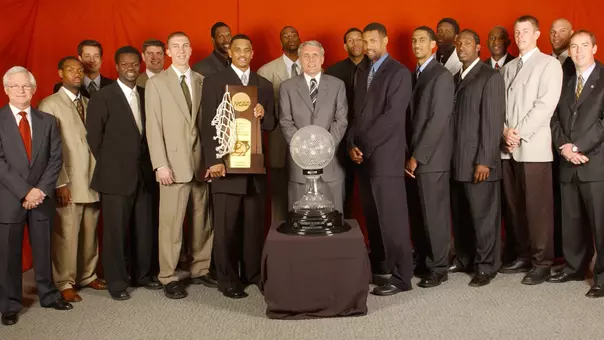
A Closer Look at Gary Williams
7/16/1999 8:00:00 AM | Men's Basketball
July 16, 1999
Gary Williams, who is looking forward to his 11th season at the head coach at the University of Maryland, is only one victory away from capturing the 400th of his career. As proud as he is of his many accomplishments on the court, he is also very proud of his accomplishments off the court. Among those is the pride he exhibits in his support of the Coaches vs. Cancer program. He is on the board of directors of the program an annually raises money which is donated to the program. The program was developed to support the American Cancer Society and its goal to eliminate cancer as a major health problem.
3-Pointers on Life Few coaches have had as diverse a career as Gary Williams, who has helped keep the University of Maryland near the top of the Atlantic Coast Conference after stints at Ohio State and Boston College. His Three-Point Attack on Life focuses on dedication to his profession, a desire to help his players succeed after they leave school and a never-ending quest for improvement.
Dedication to Coaching:
Williams may be looked at from the outside in terms of wins and losses,
but to him coaching is much more than making sure his players know how
to pass, shoot, dribble, defend and rebound. He considers himself a
teacher, a designation he takes quite seriously.
"I've always considered coaching to be teaching," Williams says. "I want to be a very good teacher. There are a lot of good things that you can learn as a player on a team that aren't connected to basketball. They're connected to life. "Wins and losses are how we're graded at this level, but I grade myself differently. I look at other things, beyond basketball."
His Players' Success:
Several of Williams' players have gone on to play professionally, but
his interest in his teams' future doesn't stop with the NBA. Williams
wants to make sure each of his players prepares himself for a future
that doesn't include the hardwood. When that happens, Williams
considers his time well spent.
"Guys like (former Maryland stars) Joe Smith and Keith Booth have gone to the NBA, and that's great. But I look at my ninth, 10th and 11th men on the team and see how they do. I worry about them as much as I do about a star player, because they're the ones who go out and get jobs and start families away from the spotlight. If they're successful, they make great role models.
"That's one of the rewarding parts of coaching that no one sees. For every Joe Smith in the NBA, there are 20 guys who are just like the rest of the student body. They finish college and go out and get jobs. The message that I want to get across to my players is that college is for academics first, and if basketball is not there at the end, you still have an education. I try to make them believe that even if they don't go to the NBA, they're successful. You go to college to give yourself options later on in life."
Constant Improvement:
Even if Maryland were to have an undefeated season and win the national
championship, Williams would still be looking for ways to get better.
He realizes that those who don't evolve and grow will be passed by,
particularly in a business as competitive as college basketball.
"If I ever thought I knew all there was about basketball, it would be time to get out. You can get better every year. You have to have the hunger and drive to learn new ideas and concepts. As long as you continue to do that, you'll be a success.
"Good teachers improve every year. They may be teaching the same subject, but they'll try new methods. I feel the same way."
On Coaches vs. Cancer:
Williams was the same age as Jim Valvano, the North Caroline State coach
who died of cancer and who had become close friends with Williams when
they were coaching at rival schools at the beginning of their careers.
When Valvano passed away, it forced Williams to take stock of his life
and be happy for what he had.
Williams also lost his mother to cancer when she was in her early 60s, and that hit home with him. Because he, like just about everyone else, has been touched by the disease, he wants to do what he can to fight it.
"People have to understand that coaches are in a position to affect some things. We can combine coaching basketball with the fight against cancer and put up a good fight. Coaches be nature are very competitive, and they want to join in good fights."
GARY WILLIAMS UNPLUGGED
COLLEGE ATTENDED: Maryland
COACHING MENTOR: (Iowa coach) Tom Davis. I was an assistant under him at Lafayette.
FAVORITE PLAYER: I hate to pick one guy.
KEY ACCOMPLISHMENT: Probably coaching in the Big East, Big Ten and ACC. I think I'm the only coach to have done that.
MY INSPIRATIONS: My junior high school coach, Neil Thompson, and my high school coach, John R. Smith. They gave me the idea that a coach was somebody more than just a person who made you a good basketball player. They kept me doing well in school so that I could get to college.
FAVORITE QUOTATION: "The strength of the wolf is in the pack, and the strength of the pack is in the wolf." That comes from Rudyard Kipling, and it applies to a team.
FAVORITE PEP TALK: I like to ask players about their pride and ability to play. There are a lot of people out there who don't play any sport, and they'd love to trade places with my players. I remind players when they're feeling sorry for themselves that it's a great thing to be able to play college basketball.
PET PEEVE: Players who are talented and don't love the game. It's such a great game, and if you have talent, you should be happy playing it.
GREATEST MOMENT ON/OFF THE COURT: When my daughter, Kristin, was born.
MOST EMBARRASSING ON-COURT MOMENT: I was coaching at Boston College in the 1983-84 season, and I bent down on the sideline, and my pants ripped. It was early in the game, so you know I didn't take my coat off that day. At halftime, I made sure I had a lot of people around me when I walked off the court.