2002 Throwback: No. 2 Maryland 112, Virginia 92
2/21/2022 8:40:00 AM | Men's Basketball
(Cole Field House)


- In the final game in the Terps' 47-year stay at Cole Field House, the nation's second ranked team routed Virginia, 112-92.
- The Terps closed out Cole in style, led by 23 points from Juan Dixon, 21 points and 11 rebounds from Chris Wilcox and 18 points from Lonny Baxter.
- Maryland completed the 2002 season 15-0 at home and notched the best regular season in school history.
- Before the game, Maryland honored seniors Dixon, Baxter, Byron Mouton and Earl Badu.
- Freshman guard Andre Collins scored the final points in Cole, hitting a 3-pointer in the final seconds.
- Post-game, a ceremony featuring numerous Maryland greats was held to score the final basket in Cole, with each passing the ball to one another down the length of the floor.
- "We wanted to win this game to stay unbeaten at home. We understood what we had to do to take care of business." - Steve Blake
- "We wanted to go out with a win. It was an emotional night, a terrific night. "Given what was going on tonight, we really enjoyed it." - Juan Dixon
- Watch the full game.
Cole May Be Empty, but It's Full of Memories
Published: 3/4/02 - Washington Post


Pauley Pavilion at UCLA, Cameron Indoor Stadium at Duke, the Palestra in Philly, Allen Fieldhouse at the University of Kansas, and Cole Field House. That's my list, though the order changes occasionally, of the great college basketball cathedrals, the places that when I walk in I still genuflect. It's impossible to write the history of college basketball without them. They are as important to the culture of college hoops as Lambeau Field is to pro football, as Boston Garden was to pro basketball, as Yankee Stadium is to baseball.
And when one is closed, when the lights are turned out forever, there is no replacing it. New cathedrals aren't built; they evolve with all their quirks and unique dimensions, their sounds and smells. The University of Maryland is moving into a shiny new arena next season for the same reason the Bulls left the friendly confines of Chicago Stadium for the cavernous and sterile United Center. It's about sky suites and new revenue streams, and the ability to show recruits that this program is as committed as the other guy is to being up-to-the-minute and state-of-the-art. When it costs nearly as much to renovate the old gym as it does to construct a new palace, it's time to say goodbye, as is the case with Cole Field House.
About 20 minutes before last night's farewell at Cole, former Maryland all-American Len Elmore stood out back reminiscing with another former all-American, Albert King. Inside, people were making toasts, re-telling stories for the 1,000th time. "It's like a wedding now," Elmore said, talking about the pregame celebrations. "But afterward, it'll feel like a funeral."
From 1982 to '85, I was The Post's beat writer covering athletics at the University of Maryland. And the thing I loved most was getting to sit courtside in Cole virtually every home game for three seasons (not to mention 19 years' worth of other random games). Everywhere I looked at Cole last night brought back memories. To my right sat Buck Williams, who I can still see holding off Ralph Sampson. Walking down the main aisle was Albert King, who I can still see in head-to-head confrontations with Mike O'Koren and Gene Banks. To my left sat Adrian Branch, whose 29 points led Maryland to victory one early March afternoon when Sampson and Virginia were ranked No. 1. I still haven't had it adequately explained to me why Branch's No. 24 jersey isn't vertical in the Cole rafters.
Like going to Wrigley Field and looking at the same field where Babe Ruth played, you could look out at the old floor in Cole, scarred and blond in some places, close your eyes and see Michael Jordan and Lew Alcindor, Charlie Scott and Pat Riley, David Thompson and Phil Ford, and, yes, Len Bias, running up and down under the same old arched roof. I loved Cole because it was large enough to be a real arena but small enough to be intimate. And that enabled it to be as loud as the Palestra, if not Cameron Indoor. And for that, folks can thank Lefty Driesell for putting those six or so rows of temporary seats close to the floor.
Okay, you want a favorite memory? Here's mine: I can't recall whether anybody threw him a pass or whether he took it in himself, but Bias wound up going so high to throw down a dunk that he landed piggy-back on the shoulders of 7-foot Brad Daugherty.
I remember Sherman Douglas, all 6 feet of him, dunking a lob pass over the top of 6-10 Danny Ferry during Spingarn vs. DeMatha. In fact, the high school classics involving Alcindor and Coach Morgan Wootten and the NCAA tournament games involving storied Texas Western and UCLA are what perhaps separate Cole Field House from the other great basketball cathedrals.
I remember Driesell stomping, Dean Smith granting me an interview in the infamous tunnel when I was 22 years old and completely terrified. My God, do I remember the dunk Jordan threw down for some slight, real or perceived, from some game years earlier against Adrian Branch. I remember playing pickup games with Boomer Esiason, games that might have gotten a certain star quarterback in big trouble had coach Bobby Ross known. I remember the sweet passes of Keith Gatlin. And I'll remember that last melancholy ceremony, star players symbolically passing a basketball from one to another, from Tom McMillen to Elmore to Mo Howard and so on, thinking I would have given a year of my own life for Bias to be here.
If you're going to close a joint like this, you might as well do it in style, and that's what Maryland did. This isn't the most talented Maryland basketball team ever; that honor will forever rest with the McMillen-Elmore teams that played for Driesell. The most talented team ever didn't even get to the NCAA tournament, a victim of time and structure. But using the universal standard of winning and losing, this is the most accomplished team the school has had. It lost one game in the ACC season, at Duke. It won each of the 15 games played at Cole Field House
Faced with a desperate rival of an opponent yesterday in The Finale, Maryland beat Virginia good, put six players in double figures, and ran and passed with passion and purpose if not complete precision (11 turnovers). It's a team that's as ready as can be for the ACC tournament, for the NCAA tournament, for the madness that March brings. While yesterday was a night to say goodbye to an old friend, the Terrapins would do well to take all the emotion, the fond feelings, the good will and the spirit of a grand old home into the tough nights ahead.
Copyright The Washington Post Company March 4, 2002
Saying So Long to a House of Hoops; Maryland's Cole Field House Hosts Last College Basketball Game
Published: 3/4/02 - Washington Post


At 5:10 p.m. yesterday, a freshman substitute named Andre Collins bounced the first basketball on the last day Maryland would ever play a game on its historic hardwood in Cole Field House. Collins came down the concrete hallway leading from the Terrapins' dressing room and, just as hopeful youngsters have done since 1955, stepped onto the polished floor to warm up. It was the beginning of the end for one of America's most storied and distinctive campus arenas.
After the Terrapins concluded a 15-0 farewell home season with a 112-92 rout of Virginia last night before a sellout crowd of 14,500, Cole Field House disappeared as a college hoop temple just as have many of the sport's landmarks across the country. Next season Maryland will play nearby on campus in an ultra-modern Comcast Center, whose 17,100 seats include the trademark of new sports facilities, luxury suites. Modern technology helped signal the end of an era when the Web site eBay offered two coveted courtside seats to the last game in Cole for $1,200.
"Boy, it's kind of a melancholy thing for me," said Dave Cassel, a 1979 Maryland graduate and season ticket holder who shopped for Terrapins shirts on the concourse. "I took a couple of exams in here, believe it or not. I'll never forget January 1979, beating Notre Dame, which was ranked number one, by a point. I sat right over there." He pointed toward the rows just inside the front doors, adding, "It's sad to leave. I'm looking forward to the amenities of the new place. But I hope the atmosphere transfers. That's the real key for me -- the atmosphere."
Cole had it -- for more than Maryland basketball, too. It was the site of two men's NCAA championship games, including the history maker of 1966, when Texas Western became the first team to start an all-black lineup in a national title game and defeated Adoph Rupp's all-white Kentucky team. Six NCAA regional tournaments also were held at Cole as were five NCAA wrestling championships, NCAA women's volleyball, an annual indoor track meet, a number of significant high school games and state championship games and a 1972 table tennis match that marked the first sporting event between the United States and China.
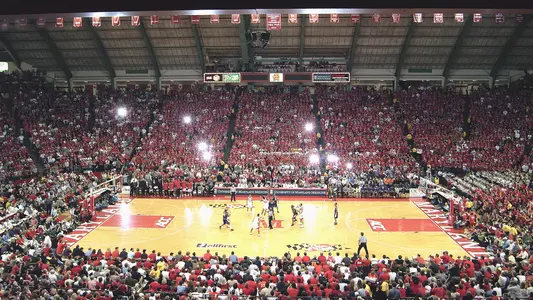
Last night the place became a sea of red as an excited crowd packed the Terrapins' old home for the last time. Miles Resnick, Maryland '69, came to a stop amid a crush of people on the concourse who were trying to buy programs and other souvenirs, shouting that he had come all the way from his home in Beaumont, Tex., for the final game. Michael Miller and Nancy Gwozdz, wed Saturday evening, delayed their honeymoon long enough to attend. Morgan Wootten, who made history in Cole by coaching DeMatha to a victory in 1965 that ended Lew Alcindor-led Power Memorial's 71-game winning streak, sat behind the Maryland bench.
Others, it seemed, had been in Cole forever -- actually, game after game and season after season.
Charlie White, 79, worked for the final time as an usher at the top of the stairs between sections D and E. "Fourth row from the bottom on the right," he told a woman who had asked directions. White knew the way; he has been an usher back to the days of Griffith Stadium -- 63 years in all. Another woman who passed by him on the way to her seat clasped his hand, and he responded with a smile. "They're all my friends," White said.
George Atwell, 69, of Leesburg, sat in Section Q for Maryland's first game in Cole, Dec. 2, 1955 -- Virginia played that game, too, and Maryland won, 67-55. For years the Maryland grad has been a courtside season ticket holder in Section F, opposite the student sections. "When you're sitting over here looking over at the student body and Maryland has just scored 10 straight points, it's a hard feeling to describe," he said.
Like many, Atwell thrilled not only to the games but also times spent with people he came to know. At first the place looked massive to him but soon he found that actually it was compact -- every seat a good one.
"The first time I walked in here," he said, "I thought this was the biggest building I had ever seen." His affection for Cole never wavered.
Longtime ticket-taker George Krebs, intent on his work with head bent, sounded wistful as he moved people along swiftly indoors. "It's kind of sad to see it close," he said. "The Duke and North Carolina games were the big games -- every year."
"The atmosphere this season has been unreal," said Jack Zane, a former Maryland sports information director who now heads up a "Walk of Fame and History" in the new arena. "For the Duke game, almost every single person was in the building for the national anthem. You hardly ever see that -- except maybe tonight."
Maryland and Virginia tipped off to a blaze of camera flashes. The emotion of the evening had long been building, and the finale attracted many former Terrapin athletes. Among them were Buck Williams, Len Elmore, Jay and Tom McMillen, Jim O'Brien, Adrian Branch, Albert King, Keith Booth and Boomer Esiason. Football coach Ralph Friedgen squeezed in.
For the closing ceremonies, Maryland brought back scores of familiar contributors to Cole's legend. These included the 1955-56 team, the first to play at Cole; the 1957-58 team, Maryland's first NCAA tournament team; Bud Millikan, who coached those teams; about 30 Terrapin all-Americans and all-conference players, and five season ticket holders who attended games in the pre-Cole days of Ritchie Coliseum and the 47 years of Cole -- with their next stop the new arena.
Four current Terrapins were honored on what also was senior night: Lonny Baxter, Juan Dixon, Byron Mouton and walk-on Earl Badu. Badu received an ovation the likes of which expressed fans' hearty appreciation for his contributions to the Terrapins' recent seasons; he would get into the game with 1:46 to play and score the only basket of his career, a driving layup. "Moo-o-o," came the cry for Mouton. A deafening roar from the crowd greeted both Baxter and Dixon.
After the 637th and final Maryland game in the building, which Collins concluded with a three-pointer with 0.5 seconds left, Millikan and one of his former players, current Maryland coach Gary Williams, took part in a ceremony of "ball-passing" among players from the team's all-time roster down through the years. "Gary, Gary," the crowd chanted for the only coach to have taken the Terrapins to the Final Four. Williams, in turn, said that his "happiest moment" in Cole "was in Section Q when I passed two final exams" to graduate. Steve Blake made an honorary last basket, stuffing the ball after being boosted up by Tahj Holden. The ball ended in the hands of student government association president Angela Lagdameo as Cole was turned over to the students for campus activities.
They inherited a basketball temple, a distinctive structure with a history rich enough to put it in company with some of the finest campus arenas in the nation. Basketball shrines continue to dwindle but still exist at such places as, among others, Kansas, Duke, Vanderbilt, Butler, Pennsylvania, Minnesota and Oregon.
Visitors still will be able to enter Cole and linger on its familiar concourse ringing the top row of seats. But as far as college basketball is concerned, such visits will be only to reminisce.
Copyright The Washington Post Company March 4, 2002
- No. 4 Maryland 76, No. 2 Illinois 63
- No. 4 Maryland 112, North Carolina 79
- No. 3 Maryland 91, No. 5 Virginia 87
- No. 3 Maryland 87, No. 1 Duke 73