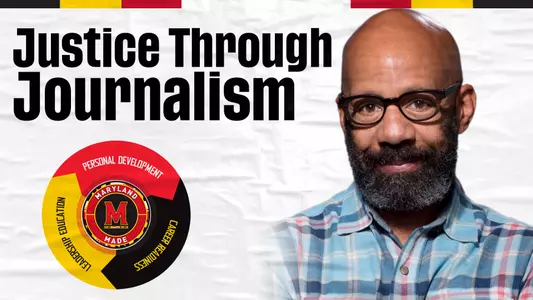
Maryland Made, Blackistone Hold Justice Through Journalism Seminar
10/14/2020 11:00:00 AM | Maryland Made
The Maryland Made program empowers student-athletes to become leaders, develop professional competencies, and be conscientious advocates. Last week, Maryland Made teamed up with professor Kevin Blackistone to provide insight to student-athletes on careers in journalism and how the field of journalism can put prospective students into a position to advocate for social justice.
Blackistone is a professor for the Philip Merrill College of Journalism at the University of Maryland as well as a frequent panelist on ESPN's Around the Horn. He is also a native of Washington, D.C., grew up in Hyattsville, Maryland, and attended Our Lady of Good Counsel High School.
Blackistone covered topics such as the role of sports in a politically driven society as well as the theory behind uncovering injustices in sports. One example, he mentioned, was the comparison of Tom Brady being thought of as a cerebral quarterback in the NFL while Cam Newton is praised for his physicality as a quarterback in the NFL. Obviously, underlying racial biases play a role in how athletes – both professional and amateur – are perceived, but Blackistone's message was that it is on sports journalists to not perpetuate myths like these.
Blackistone expanded on both this topic and brought up an NBA example by saying, "You don't think of it consciously but even subconsciously, you might begin to think that Cam Newton is something less than he is. That somehow, his ability to play football is an innate ability rather than the learnability. You don't realize that a great shooter in the NBA like Larry Bird and a Ray Allen – or even Jamal Murray – they all practice that. They didn't come out of the womb with the ability to shoot 40 percent from the three-point line. That's practice."
Maryland student-athletes were given chances to ask questions of Blackistone such as the future of women in sports and how important it is that they get a fair shot in the industry.
"I would hope so," responded Blackistone. "We've seen [ESPN Analyst] Maria Taylor has been in the news … Doris Burke is probably now as revered a pro basketball commentator as anyone on the sidelines...I would hope so. But here's what I hope more: I hope more women are able to be as successful in sports journalism, particularly on air, as men without having to be objectified based on their aesthetics. I just hope that women start to get judged that in a way that men are also judged because men are not judged on how good they look."
Sports have long been ingrained into American society but the role of sports and social justice issues have not been clear until tragedies such as the George Floyd incident rocked the nation.
"We have come to see sports become a platform for critical issues in society," Blackistone said. "Despite the fact that you hear people suggest that athletes need to stay in their lane and sports are a place to escape the problems of society, sports have never been about that. Sports is not just entertainment, it is a means towards liberation. People have to think about it like that. For women who are athletes, it too has been a liberating force in this country, to provide for them a platform in which they can prove their equal status with men."
Maryland's student-athletes weighed in to digest and bring up topics of their own after hearing from Professor Blackistone.
"I really appreciated his perspective as a woman entering the sports marketing world," said Kelee Lepage, a senior on Maryland's field hockey team. "Especially because women in sports are still objectified. That might be something I experience, but knowing that I'm not the only one and just knowing that it is becoming more aware."
Will Koras, a sophomore on the men's golf team, found an example of his own where racial biases uncover injustices in professional sports.
"I've been watching [Ravens quarterback] Lamar Jackson for the last three years," Koras said. "He'll get talked about just being an athlete and an athletic person, not a smart and intelligent quarterback. And you don't really realize when it's happening."
The three pillars of the Maryland Made culture are career readiness, leadership education, and personal development. Blackistone's message embodied the culture of the Maryland Made program and offered valuable insight and education to student-athletes interested in both the journalism fields as well as social justice advocacy.
Blackistone is a professor for the Philip Merrill College of Journalism at the University of Maryland as well as a frequent panelist on ESPN's Around the Horn. He is also a native of Washington, D.C., grew up in Hyattsville, Maryland, and attended Our Lady of Good Counsel High School.
Blackistone covered topics such as the role of sports in a politically driven society as well as the theory behind uncovering injustices in sports. One example, he mentioned, was the comparison of Tom Brady being thought of as a cerebral quarterback in the NFL while Cam Newton is praised for his physicality as a quarterback in the NFL. Obviously, underlying racial biases play a role in how athletes – both professional and amateur – are perceived, but Blackistone's message was that it is on sports journalists to not perpetuate myths like these.
Blackistone expanded on both this topic and brought up an NBA example by saying, "You don't think of it consciously but even subconsciously, you might begin to think that Cam Newton is something less than he is. That somehow, his ability to play football is an innate ability rather than the learnability. You don't realize that a great shooter in the NBA like Larry Bird and a Ray Allen – or even Jamal Murray – they all practice that. They didn't come out of the womb with the ability to shoot 40 percent from the three-point line. That's practice."
Maryland student-athletes were given chances to ask questions of Blackistone such as the future of women in sports and how important it is that they get a fair shot in the industry.
"I would hope so," responded Blackistone. "We've seen [ESPN Analyst] Maria Taylor has been in the news … Doris Burke is probably now as revered a pro basketball commentator as anyone on the sidelines...I would hope so. But here's what I hope more: I hope more women are able to be as successful in sports journalism, particularly on air, as men without having to be objectified based on their aesthetics. I just hope that women start to get judged that in a way that men are also judged because men are not judged on how good they look."
Sports have long been ingrained into American society but the role of sports and social justice issues have not been clear until tragedies such as the George Floyd incident rocked the nation.
"We have come to see sports become a platform for critical issues in society," Blackistone said. "Despite the fact that you hear people suggest that athletes need to stay in their lane and sports are a place to escape the problems of society, sports have never been about that. Sports is not just entertainment, it is a means towards liberation. People have to think about it like that. For women who are athletes, it too has been a liberating force in this country, to provide for them a platform in which they can prove their equal status with men."
Maryland's student-athletes weighed in to digest and bring up topics of their own after hearing from Professor Blackistone.
"I really appreciated his perspective as a woman entering the sports marketing world," said Kelee Lepage, a senior on Maryland's field hockey team. "Especially because women in sports are still objectified. That might be something I experience, but knowing that I'm not the only one and just knowing that it is becoming more aware."
Will Koras, a sophomore on the men's golf team, found an example of his own where racial biases uncover injustices in professional sports.
"I've been watching [Ravens quarterback] Lamar Jackson for the last three years," Koras said. "He'll get talked about just being an athlete and an athletic person, not a smart and intelligent quarterback. And you don't really realize when it's happening."
The three pillars of the Maryland Made culture are career readiness, leadership education, and personal development. Blackistone's message embodied the culture of the Maryland Made program and offered valuable insight and education to student-athletes interested in both the journalism fields as well as social justice advocacy.
Thursday, June 25
Wednesday, September 18
Tuesday, September 17
Monday, July 10




